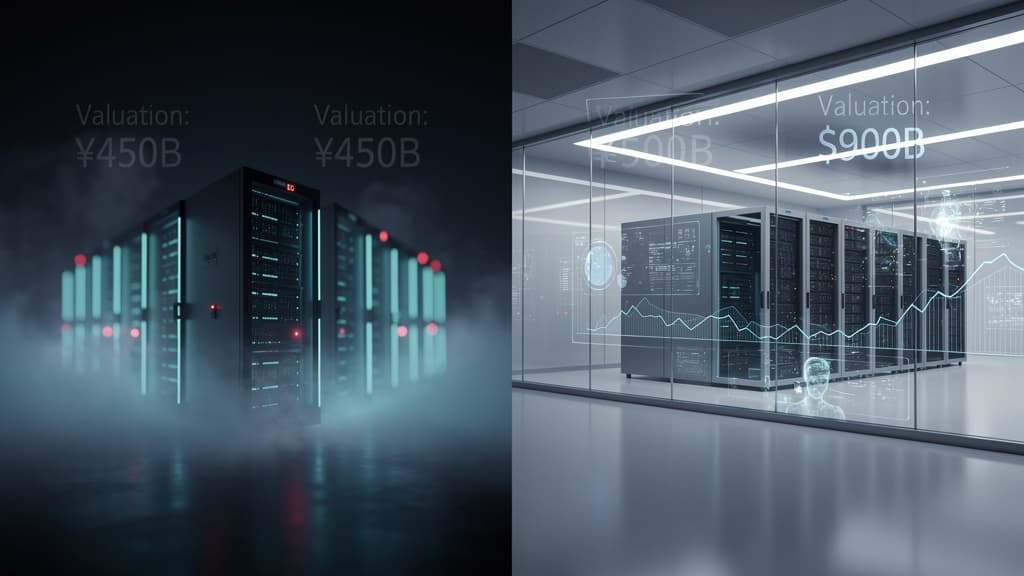
Forget the software hype; the real future of enterprise AI is written in silicon. Discover how record-breaking hyperscaler profits are dictating the business landscape for 2026.
When analyzing generative ai business trends 2026, the most critical indicator isn't found in software adoption surveys, startup valuations, or the latest benchmark scores of large language models. Rather, the definitive blueprint for the future of enterprise AI is being written in the staggering, unprecedented capital expenditures of hyperscale cloud providers and the resulting profits of hardware manufacturers. If you want to know where the global economy is heading, stop looking at the application layer. Look at the silicon.
For the past two years, a vocal contingent of industry analysts has warned of a "generative AI bubble." They have argued that the massive infrastructure build-out by tech giants is a speculative frenzy—a bridge to nowhere built on the assumption of future software revenue that may never materialize.
Recent financial disclosures have definitively shattered that narrative. The foundational hardware and cloud infrastructure layers are generating historic returns, proving that the shift toward generative AI is not a temporary hype cycle, but a permanent, structural transformation of the global computing landscape.
This infrastructure mandate is dictating how businesses must operate, invest, and scale in 2026.
The Silicon Truth: Decoding a 48-Fold Anomaly
To understand the gravity of the current market shift, we must look at the raw physical materials powering it.
In late April 2026, Samsung reported a staggering 48-fold profit jump for its semiconductor unit, driven entirely by an AI-fueled memory shortage [https://www.bloomberg.com/news/articles/2026-04-29/samsung-s-chip-profit-soars-48-fold-on-ai-fueled-memory-shortage].
A 48-fold (4,800%) profit increase in a mature, capital-intensive industry like semiconductor manufacturing is a structural anomaly. It does not happen because of a passing trend. It happens when systemic, insatiable demand meets the physical limits of global supply chains.
The bottleneck in training and running next-generation frontier AI models is no longer just compute (GPUs); it is memory. High Bandwidth Memory (HBM) is essential for feeding data into AI processors at the speeds required for massive parallel processing. Samsung's historic profit surge indicates that hyperscalers—companies like Microsoft, Meta, Google, and Amazon—are buying every available high-performance chip off the line, regardless of the premium.
"This massive infrastructure build-out highlights the immense hardware demand required to train and run next-generation frontier AI models."
This level of capital allocation signals a point of no return. Hyperscalers are not gambling; they are securing the foundational resources required to power the next decade of enterprise technology. For business leaders, this 48-fold jump is a flashing neon sign: the infrastructure to support autonomous agents, multi-modal generative systems, and real-time enterprise AI is being cemented into place right now.
The Cloud Consumption Proof
The most common counterargument to the "AI is permanent" thesis is the "CapEx Bubble" theory. Skeptics argue that while hyperscalers are spending billions on hardware, enterprise software revenues aren't growing fast enough to justify the cost. They suggest that cloud providers are merely hoarding chips to train their own models, creating an artificial demand cycle that will inevitably crash when the models fail to generate downstream ROI.
But the data tells a different story. The consumption layer is catching up to the infrastructure layer.
Amazon recently reported its biggest cloud sales jump since 2022, fueled directly by AI demand [https://www.bloomberg.com/news/articles/2026-04-29/amazon-reports-biggest-cloud-sales-jump-since-2022-on-ai-demand]. This is the missing link that validates the entire ecosystem.
If the AI boom were purely a hardware bubble, we would see Amazon Web Services (AWS) purchasing massive amounts of silicon while their external cloud revenue remained flat. Instead, AWS is seeing its fastest growth in years. This proves that downstream enterprises—banks, healthcare networks, logistics giants, and SaaS providers—are actively renting this compute power. They are moving generative AI out of the sandbox and into production environments. They are paying for inference, fine-tuning, and managed AI services at a scale that is directly driving hyperscaler top-line revenue.
The hardware is being bought, the servers are being racked, and—crucially—the compute is being consumed.
Reframing the Generative AI Business Trends 2026
If we accept the premise that hyperscaler CapEx and cloud consumption are the ultimate leading indicators, we must radically re-evaluate the core generative ai business trends 2026. The conversation must shift from "What can AI do?" to "How do we survive and compete in an AI-first infrastructure reality?"
Here are the three definitive trends dictated by the current hyperscaler economics:
1. Compute as a Strategic Corporate Asset
In a world where semiconductor profits are soaring due to shortages, compute is no longer a limitless utility; it is a constrained strategic asset. Businesses can no longer assume that massive, cheap cloud compute will always be available on demand.
Forward-thinking enterprises are moving away from purely on-demand cloud pricing and are locking in long-term compute contracts, securing dedicated instances, and even investing in on-premise AI hardware for highly sensitive workloads. If hyperscalers are fighting over memory and silicon, enterprise CIOs must fight for guaranteed allocation. Securing compute is now as critical to a modern business as securing supply-chain logistics is to a manufacturer.
2. The Great Migration to Production
Amazon's cloud growth indicates that the era of the "pilot purgatory" is ending. In 2024 and 2025, companies experimented with generative AI wrappers and internal chatbots. In 2026, the financial data proves that businesses are integrating AI into their core operational workflows.
Whether it is autonomous customer service agents resolving complex tier-2 tickets, AI-driven supply chain forecasting, or generative code assistants deeply embedded in CI/CD pipelines, the ROI is finally being realized. Companies that are still treating generative AI as an innovation lab experiment are actively losing ground to competitors who are driving AWS's historic sales jump.
3. The Rise of Model Distillation and Efficiency
Paradoxically, the massive cost of frontier models is driving a counter-trend in enterprise adoption: the aggressive optimization of smaller models. Because running massive 1-trillion-parameter models is incredibly expensive (as evidenced by the hardware costs), businesses are increasingly relying on hyperscaler infrastructure to train models, but using techniques like model distillation, quantization, and RAG (Retrieval-Augmented Generation) to deploy smaller, hyper-efficient models at the edge.
The trend for 2026 is not every company running a massive frontier model; it is companies fine-tuning 8-billion to 70-billion parameter models that offer 95% of the performance at 10% of the inference cost.
The Call to Action: Build for the New Normal
We must stop treating the current AI landscape as a speculative bubble waiting to burst. The financial physics of the market simply do not support that narrative. When a hardware provider like Samsung sees a 48-fold increase in profit, and a cloud provider like Amazon sees its highest growth in four years simultaneously, it represents a synchronized, multi-tier validation of the technology.
The generative AI business trends 2026 are not being dictated by thought leaders or software evangelists; they are being dictated by the cold, hard reality of capital expenditure. Hundreds of billions of dollars are being poured into the physical foundation of a new digital economy.
For enterprise leaders, the mandate is clear. Stop waiting for the dust to settle. The foundation has already been poured, the servers are online, and your competitors are already buying the compute. It is time to build.
Last reviewed: April 30, 2026