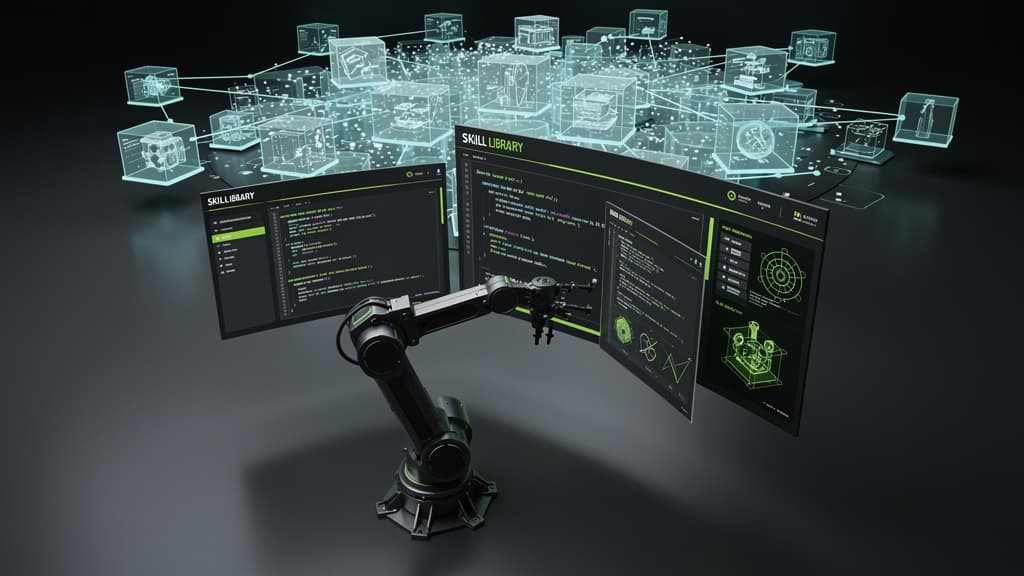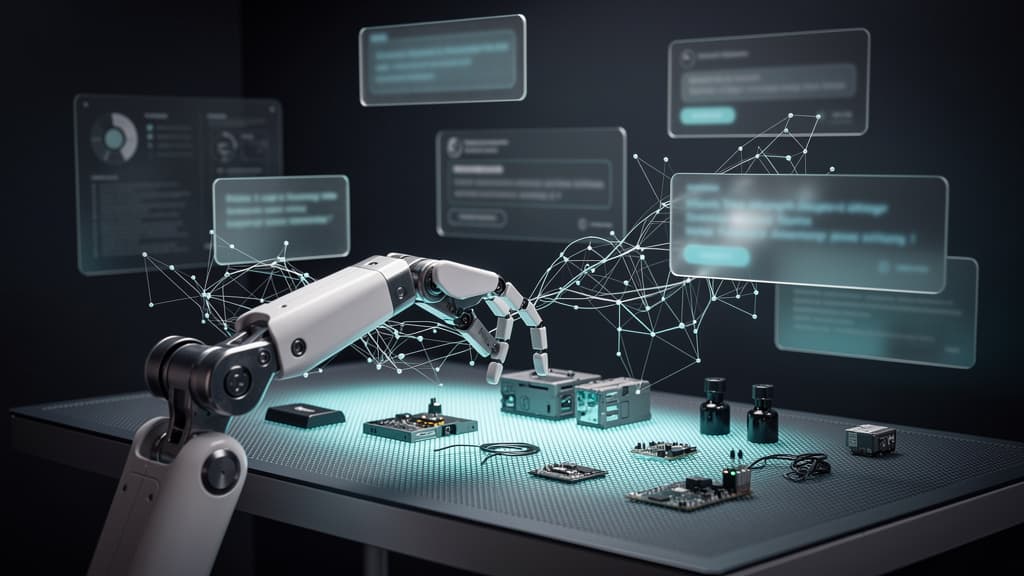
Physical Intelligence is using large language models to bridge the gap between digital reasoning and physical execution, offering a new path for integrating AI into complex legacy industrial environments.
Can Physical Intelligence Solve the Robot Task Gap?
For decades, robotics has struggled with a fundamental contradiction: machines that can perform surgery with sub-millimeter precision yet fail spectacularly when asked to fold a towel. The gap between digital reasoning and physical execution has been one of the most stubborn problems in AI — until now. Physical Intelligence, a San Francisco-based robotics startup, is attacking this problem from a novel angle: using the broad, generalized knowledge already embedded in large language models to help robots understand natural language instructions and independently learn to execute virtually any physical task.
This isn't incremental robotics engineering. It's a fundamental rethinking of how machines acquire physical competence — and it has serious implications for anyone thinking about AI integration strategies for legacy systems in manufacturing, logistics, healthcare, and beyond.
The Core Problem: Why Robots Don't Generalize
Traditional industrial robots are programmed for specificity. A robotic arm on an automotive assembly line is extraordinarily good at one thing: repeating a precise sequence of movements within tight tolerances. Change the task — even slightly — and the system breaks. Reprogramming is expensive, time-consuming, and requires specialized engineers.
This brittleness is the defining characteristic of first and second-generation robotics. It's also why, despite decades of investment, robots have failed to penetrate the vast middle ground of physical work: environments that are unstructured, variable, and require contextual judgment. Warehouses, kitchens, elder care facilities, and general-purpose manufacturing all fall into this category.
The conventional solution has been task-specific training — collecting thousands of demonstrations for each individual task, training a model on that narrow dataset, and deploying it in a tightly controlled environment. The result is a system that works, but only barely generalizes beyond its training distribution.
The core challenge isn't motor control — it's the combinatorial explosion of physical tasks that robots need to handle in the real world.
Physical Intelligence's Bet: LLM Knowledge as a Foundation
Physical Intelligence's approach, as reported by New Scientist, centers on a deceptively simple insight: large language models have already absorbed an enormous amount of human knowledge about how the physical world works. They understand that glasses are fragile, that liquids spill, that stacking objects requires stability. This semantic understanding of physics and causality — learned from text — can serve as a scaffold for robotic learning.
Rather than training robots from scratch on physical demonstrations alone, Physical Intelligence is building systems that leverage LLM knowledge to interpret natural language instructions and map them onto physical actions. The robot doesn't just receive a command; it understands the intent behind it, the constraints involved, and the context in which it's operating.
This approach bridges two domains that have historically developed in isolation:
- Language understanding — the domain where LLMs excel, processing semantic meaning, intent, and world knowledge
- Embodied AI — the domain of physical sensing, motor control, and real-world interaction
The company's architecture essentially uses LLM representations as a prior: a starting point that dramatically reduces the amount of physical demonstration data needed to teach a new task. Instead of needing 10,000 demonstrations of "pick up the red cup," the system can leverage its existing understanding of what cups are, what picking up means, and what success looks like.
Architecture Implications: Where LLMs Meet Motor Control
The technical challenge here is non-trivial. LLMs operate in token space — discrete representations of language. Physical robots operate in continuous action space — joint angles, forces, velocities, and spatial coordinates. Bridging these two representational worlds requires careful architectural design.
Physical Intelligence's approach appears to involve training foundation models for robotics — analogous to how GPT-4 or Claude serve as general-purpose language foundations, but for physical action. The key architectural elements likely include:
Multimodal Perception
Robots need to ground language instructions in visual and tactile perception. A command like "carefully move the fragile item" requires the system to identify which item is fragile, estimate its weight and fragility from visual cues, and adjust grip force accordingly. This requires tight integration between vision encoders, language encoders, and proprioceptive feedback.
Hierarchical Planning
Complex tasks decompose into subtasks. "Set the table" involves understanding the goal state, identifying required objects, planning a sequence of pick-and-place operations, and handling unexpected obstacles. LLM-based planning can handle this hierarchical decomposition naturally — it's structurally similar to chain-of-thought reasoning.
Low-Data Generalization
Perhaps the most commercially significant capability: the ability to learn new tasks from very few demonstrations. If an LLM already understands the concept of "folding" from training data, a robot system built on that foundation might need only a handful of physical demonstrations to acquire the motor skill, rather than thousands.
The Legacy Systems Integration Angle
For technology decision-makers, the implications extend well beyond humanoid robots in research labs. The principles Physical Intelligence is developing are directly relevant to AI integration strategies for legacy systems — the challenge of bringing intelligence to existing physical infrastructure without replacing it wholesale.
Consider the typical industrial environment: legacy PLCs (programmable logic controllers), fixed robotic arms from the 1990s, conveyor systems with no digital interfaces, and human workers operating alongside all of it. The conventional AI integration playbook — train a specialized model, deploy in a controlled environment — fails here because the environment is too variable and the data too sparse.
An LLM-grounded approach changes the calculus in several ways:
Instruction-following without reprogramming. If a robot or automation system can interpret natural language instructions, operators can modify its behavior without writing code. "Move slower near the packaging station" becomes an instruction, not a software change request.
Transfer across similar tasks. A system that generalizes from LLM knowledge can potentially transfer skills across tasks that share semantic structure. A robot trained to "pick and place" boxes might transfer that skill to bags, containers, or irregularly shaped objects with minimal additional training.
Human-robot collaboration. Natural language interfaces dramatically lower the barrier for human workers to direct, correct, and collaborate with robotic systems. This is critical in environments where full automation isn't feasible or desirable.
The gap between what robots can do in labs and what they can do in real workplaces has always been a data problem as much as a hardware problem. LLM-grounded systems change the data economics fundamentally.
Competitive Landscape and Validation
Physical Intelligence isn't operating in a vacuum. The broader field of robot foundation models has seen significant investment and research activity. Google DeepMind's RT-2 demonstrated that vision-language models could be fine-tuned for robotic control, showing emergent reasoning capabilities — robots that could respond to novel instructions not seen during training. Stanford's Mobile ALOHA and the broader ALOHA line of research demonstrated low-cost imitation learning at scale.
What distinguishes Physical Intelligence's positioning is its focus on task generalization as the primary product goal — not a specific robot form factor or a specific industry vertical. The company is reportedly backed by significant venture funding and has attracted researchers from leading AI labs, signaling serious technical ambition.
The competitive pressure is real: Amazon Robotics, Boston Dynamics (now under Hyundai), and Figure AI are all pursuing variations of generalist robot intelligence. But the LLM-grounding approach represents a specific architectural bet that, if it pays off, could provide a meaningful head start on the generalization problem.
Failure Modes and Open Questions
Any honest technical analysis must address where this approach could break down.
Hallucination in physical space. LLMs are known to hallucinate — generating plausible-sounding but incorrect outputs. In language, this is embarrassing. In physical robotics, it could mean a robot confidently executing a task in a way that damages objects or injures people. Physical grounding and safety constraints need to be robust enough to catch LLM-driven errors before they propagate to motor commands.
Latency and real-time constraints. LLM inference is not fast by robotics standards. Industrial control loops often operate at 1kHz or higher. Architectures that rely on LLM reasoning in the action loop will need careful design to separate fast reactive control from slower deliberative planning.
Distribution shift in physical environments. LLMs trained on text have deep knowledge of concepts but may have systematic gaps in physical intuition — particularly for edge cases, unusual materials, or non-Western physical environments underrepresented in training data. These gaps will manifest as unexpected failure modes in deployment.
Sim-to-real transfer. Much of the training data for robot foundation models comes from simulation. The gap between simulated physics and real-world physics remains a significant unsolved problem, particularly for contact-rich manipulation tasks.
What to Watch
Physical Intelligence's progress over the next 12-24 months will be a meaningful signal for the entire field. Key milestones to track:
- Benchmark performance on multi-task generalization: Can their systems perform competitively across diverse task categories without task-specific fine-tuning?
- Data efficiency metrics: How many demonstrations are needed to teach a genuinely novel task? Orders-of-magnitude improvements over baselines would validate the LLM-grounding hypothesis.
- Real-world deployment cases: Lab demos are table stakes. Sustained performance in uncontrolled commercial environments is the real test.
- Safety and reliability data: As the field matures, expect increasing scrutiny on failure rates, safety incidents, and edge-case behavior.
For practitioners thinking about AI integration strategies for legacy systems, the message is this: the era of task-specific robotic programming is ending. The question isn't whether LLM-grounded generalist robots will arrive — it's how quickly, and whether your organization's infrastructure will be ready to work with them.
The robot task gap is real, it's been persistent, and Physical Intelligence is making a technically serious bet on how to close it. The LLM-grounding approach won't solve everything — but it reframes the problem in a way that makes generalization tractable for the first time.
Sources:
- Physical Intelligence — New Scientist Profile
- Google DeepMind RT-2: arxiv.org/abs/2307.15818
- Stanford Mobile ALOHA: mobile-aloha.github.io
Last reviewed: June 22, 2026